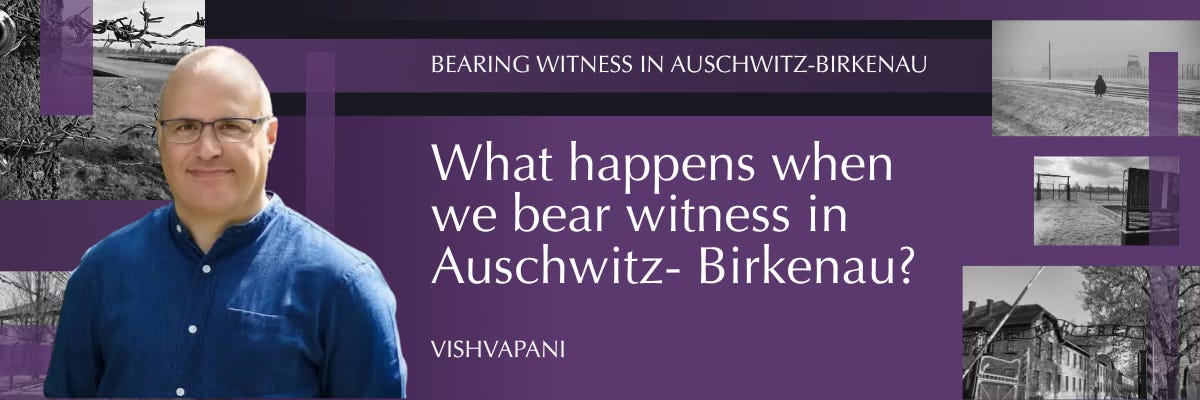
Excerpted from Pilgrimage to Auschwitz article by Vishvapani published in the book Challenging Times: Stories of Buddhist Practice When Things Get Tough.
Some years ago I attended a Bearing Witness Retreat at Auschwitz concentration camp. It as a sobering, but deeply stirring experience.
When I announced I was going to do a retreat at Auschwitz, I met many responses. Some people were shocked, as if uttering ‘Auschwitz’, was an intrusion or an assault. It is a harsh sound, which I, too, soon started to avoid. A look of pain crossed my father’s face when I told him, as if I had touched a wound. ‘What good can come of it? What will you do with that experience?’
One Buddhist friend asked, ‘It is bound to be traumatic, but what is the value of trauma? And what effect will it have on your state of mind?’ Jewish friends said, ‘I couldn’t go myself. I couldn’t bear it.’
But others were fascinated by the idea. Many people turned out to have family connections with Jews or Germans and felt fear, guilt or fascination with the Holocaust. For some it was a living presence in their lives, as it has been in mine: not a historical event; not a moral conundrum; not a metaphor for personal suffering, but a part of the world. A shadow. A possibility.
While I have left Judaism behind, I have never stopped feeling a sense of Jewishness – a cultural and historical association rather than a religious one. My Jewishness seems to manifest whether I like it or not, in the friends I make, my sense of humour, and my way of expressing myself. I have never known what to do with that connection, but in the US a movement has started, inspired by Bernie Glassman and others, of Jewish Buddhists exploring their identities.
I was also attracted by Glassman’s philosophy of ‘bearing witness’, which means facing the truth, and seeing one’s response to it without any desire to fix things. That seemed the right way – the only way – to approach Auschwitz.
The most moving part of each day for me was reciting the Kaddish. Standing by the gas chambers, we chanted in Hebrew, and read the verses in many languages.
The words of the Kaddish continued to echo when I returned to Britain.
‘Oseh shalom
bim’romav,
hu ya’se shalom,
alenu v’alkol Yisrael,
v’imru amen.’(The one who has given a universe of peace gives peace to us, to all that is Israel, to all humanity. And say, yes. Amen.)
We lit candles for the dead.
‘Fourteen thousand a day,’ Rabbi Singer said. ‘A vast stream of humanity, men, women and children, all jostled together.
And they knew.
Some at least knew what was happening.
“What’s that coming out of the chimney”, one woman asked.
“That’s us,” came the reply.’
Primo Levi writes that the SS guards taunted the prisoners by saying that not only would they be killed, but that all evidence of their fates would be obliterated.
And, if by some chance, word of the camps got out, it would not be believed.
That threat of oblivion was the worst humiliation.
One thing I could do was bear witness.
~ VISHVAPANI
Join us in Bearing Witness this November
This year, Zen Peacemakers from all over the world and all walks of life will gather again in Auschwitz-Birkenau to bear witness together. We invite you to join us.
Scholarships are available, and guidance for Raising a Mala to support travel and retreat costs.
Bearing Witness Retreat in Auschwitz-Birkenau
November 15-21, 2026
Oświęcim, Poland
Learn more and register here
Attend an Information Session:
Wednesday, September 2nd
12:00 - 1:30 pm US Eastern
Online - Open Q&A - All are Welcome
LEARN MORE
Vishvapani is a writer, mindfulness teacher, broadcaster, and contributor to BBC Radio 4’s ‘Thought for the Day’ His work centers on Buddhism and the modern world — what the tradition offers when we bring it into genuine contact with contemporary life. With four decades of Buddhist practice, he has been involved in many of the organizations and initiatives that have shaped Buddhism’s presence in Britain — working across traditions, with policymakers, and in the broader mindfulness movement. His books include Gautama Buddha: The Life and Teachings of the Awakened One and Reimagining Buddhism: Understanding Sangharakshita’s Life and Teachings.


