The Weight of Witnessing
by Philip Eugene Timm (Retreat Participant 2025)
“Remember only that I was innocent and, just like you, mortal on that day. I, too, had a face marked by rage, by pity and joy, quite simply, a human face.”
- Benjamin Fordane
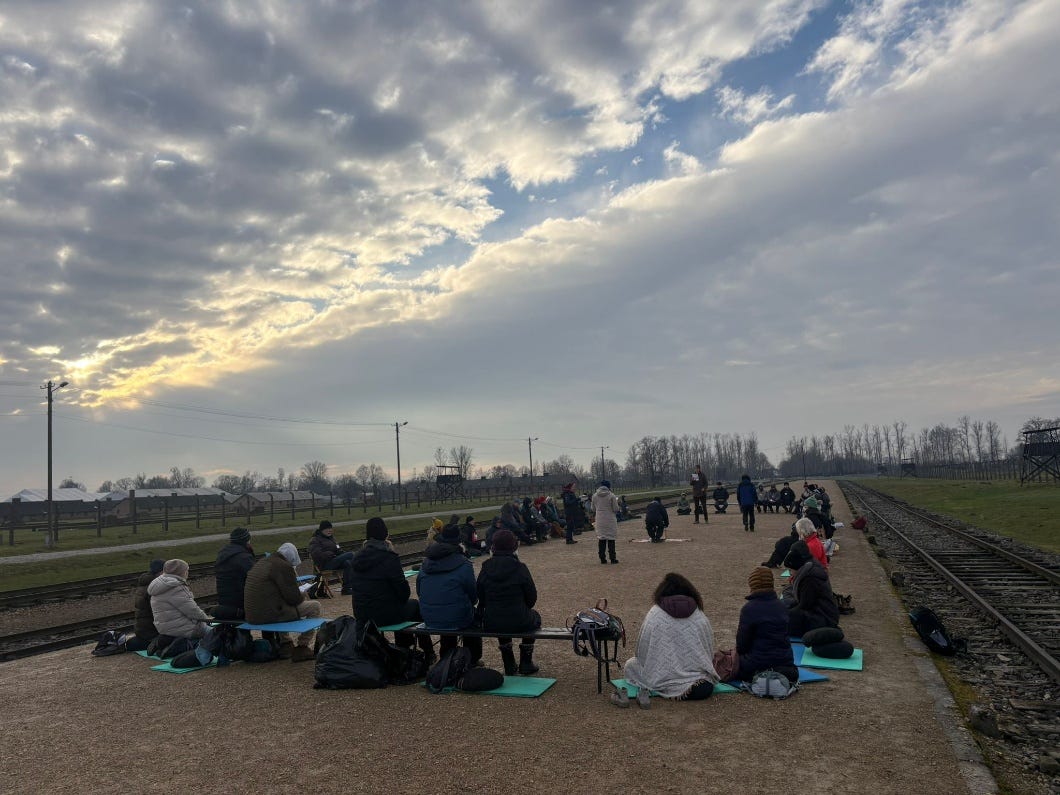
Auschwitz-Birkenau reveals itself slowly through the Polish winter—first as a distant gate, then as endless barracks stretching toward a colorless horizon, and finally as the thing itself: the largest cemetery in the world, where most of the dead have no graves. I am standing on the selection platform where a million people learned their fate in minutes, and I cannot stop shaking. Not from the cold, though it is bitter. From something else entirely. But before standing here on this platform, before the cold had entered me for good, there was the morning in Krakow when we began learning how to walk into darkness.
I cannot see a thing.
It’s just above freezing, and a wool cap is pulled so low over my face that my eyes stay closed in complete darkness. James, a classical music composer from Canada, whom I only just met, stands beside me. I take his arm, and he guides me as we leave the hotel and step out into the waking streets of Krakow. Without sight, the world opens in other ways. Footsteps scrape the pavement. German voices rise and fall around us like drifting smoke. The city hums, close and alive.
I am nervous, but I choose to trust him.
For fifteen minutes, that is all I do—trust and walk.
When we return to the hotel, we switch roles. I am leading now, and as we move through the streets, I see Sophie walking toward us. She cannot see me, blindfolded as she is, yet I recognize her instantly, the woman who had sat beside me in orientation, quiet and luminous in a way that felt like a signal. Even then, something in me stirred.
That first morning, something cracks open among us, a soft, necessary breaking of our careful shells. We are being prepared, though we do not yet know it, to witness what cannot be borne alone.
Later that morning, I sit with Anke, a doctor from Sweden, on a bench outside in the cold, hidden away from the others. We are told to share the first time we felt unconditional love. She begins, speaking simply of her children. I start crying at once. I don’t apologize. When I speak of my late daughter, Megan, the grief spills unhindered. Anke hugs me without a word, and we walk back together, leaving something unspoken and important between us. Already, I am less defended than I planned to be.
The next day, Sunday, is left open to explore Krakow. Early Monday morning, we board the bus that will take us to Auschwitz-Birkenau, where we will spend five days—mostly outdoors, mostly in silence, held inside the vast cold expanse of history’s darkest grief.
Auschwitz, the first camp, feels tight, compressed, human suffering forced inward. Birkenau is the opposite: endless, exposed, and wind-scoured, as if the earth itself is still exhaling sorrow.
Rain greets us on that first day. Relentless. Although I have brought my slicker, the rain finds its way through seams and cuffs, through good intentions, through any belief that I can remain separate from a place like this. By the time we go indoors for the introductory film, we are drenched, chilled, softened.
The days settle into a rhythm of endurance and tenderness. Morning meditation on the selection platform—an hour or more of stillness in air that hovers around freezing. Then long, silent walks across the camp: the children’s barracks, the collapsed crematoria, the ruins of the “sauna” where prisoners were stripped, shaved, disinfected, and tattooed.
For lunch, we carry our bowls—our “lifelines,” as they were for prisoners—to the gate, where a car waits with a steaming pot of soup. The same soup. The same bread. Every day. We eat on curbs, on cold stone, on frozen earth. Then we return inside, back to the platform, back to silence.
Each afternoon, we recite names. I am handed a list of fifty and add twenty-seven more—the names of those I have known to have died here, and names etched into the softest parts of my life: my daughter, my siblings. Speaking them aloud in that place is almost more than I can bear. When we finish, the papers are placed in a wooden box, a small human act against oblivion.
We begin each morning at the Center for Dialogue and Prayer: before breakfast, meditation, and then council. Each council is composed of ten individuals who meet separately from the others. In council, we are to speak only from the heart. We pass a talisman hand to hand, carrying the weight of so much sorrow, so much bewilderment.
I share a room with two German men. I arrive last and am left with the bed in the middle—my first single bed since childhood. At night, they murmur to each other in German, their voices moving back and forth over me. What was unfamiliar on the first night becomes oddly comforting by the third.
Still, each morning, I wake wanting to leave. The cold, the rain, and snow, the grief of the place, the stripping away of every habitual comfort. I feel undone. That is the word. Undone. The scale of cruelty in the children’s barracks, in the women’s quarters, in the processing rooms breaks something in me. I cannot imagine lasting more than hours here. And yet people lasted years.
One night, we return after dinner and meditate in the pitch-dark barracks. The darkness has weight. It enters the lungs. It feels like sitting inside someone else’s last breath.
On the final day, we gather at the ruins of Crematorium I. The Nazis blew it apart before fleeing, but the broken concrete remains exactly where it fell eighty years ago, like bones that refused to scatter. We place candles, one by one, and prayers rise in a dozen languages. The air is so still, I almost sense the candles flicker with memory.
Afterward, we take the long walk on the same path that so many took to their death, heading back to the gate in silence. I drift apart from the group, overwhelmed and strangely hollow. My thoughts unmoor. I do not know what to do with what has happened to me. Then Sophie comes up quietly, slips her arm through mine, and walks beside me. We leave Birkenau that way—together, silent, my tears warm against the cold.
The retreat changed me in ways I am still trying to understand. I am not the same man who arrived, nor do I wish to be. But this new skin itches; it requires constant smoothing. Some days I am on the edge of tears with no explanation, only the sense that something in me now rides just beneath the skin. After a few days in Vienna to decompress and a short visit to Paris to visit with friends, I returned home with a thinner skin, a tenderness I cannot quite manage, and a grief that moves freely beneath the surface.
People tell me I was brave to go. I don’t believe that. I was deeply uncomfortable and thought often of leaving. But it wasn’t bravery, it was simply another attempt to live deeply, something I’ve been reaching for most of my life.
If you ask why I went, I cannot tell you. I agonized for months. I journaled, prayed, spoke with trusted friends, and always knew the last day to cancel. In the end, the answer was the same answer I’ve returned to throughout my life: go and let meaning reveal itself later.
I am still waiting for that revelation, though pieces of it appear at the edges.
In these days since my return, I keep thinking about that first morning in Krakow—about being led through the darkness by a stranger, my hand on his arm, trusting what I could not see. It feels now like a quiet prophecy. At Auschwitz-Birkenau, I walked through another kind of darkness, one that required another kind of trust: trust that bearing witness matters, trust that grief is a form of prayer, trust that transformation does not arrive gently.
I am seventy-six. My leaf has been falling through the years, slowly, silently. And now—after standing in those ruins, after speaking those names, after walking out of the gates with tears on my face, I can finally see its shadow passing over the ground.
Not as a warning, but as a blessing.
A reminder to live the time that remains without turning away.

