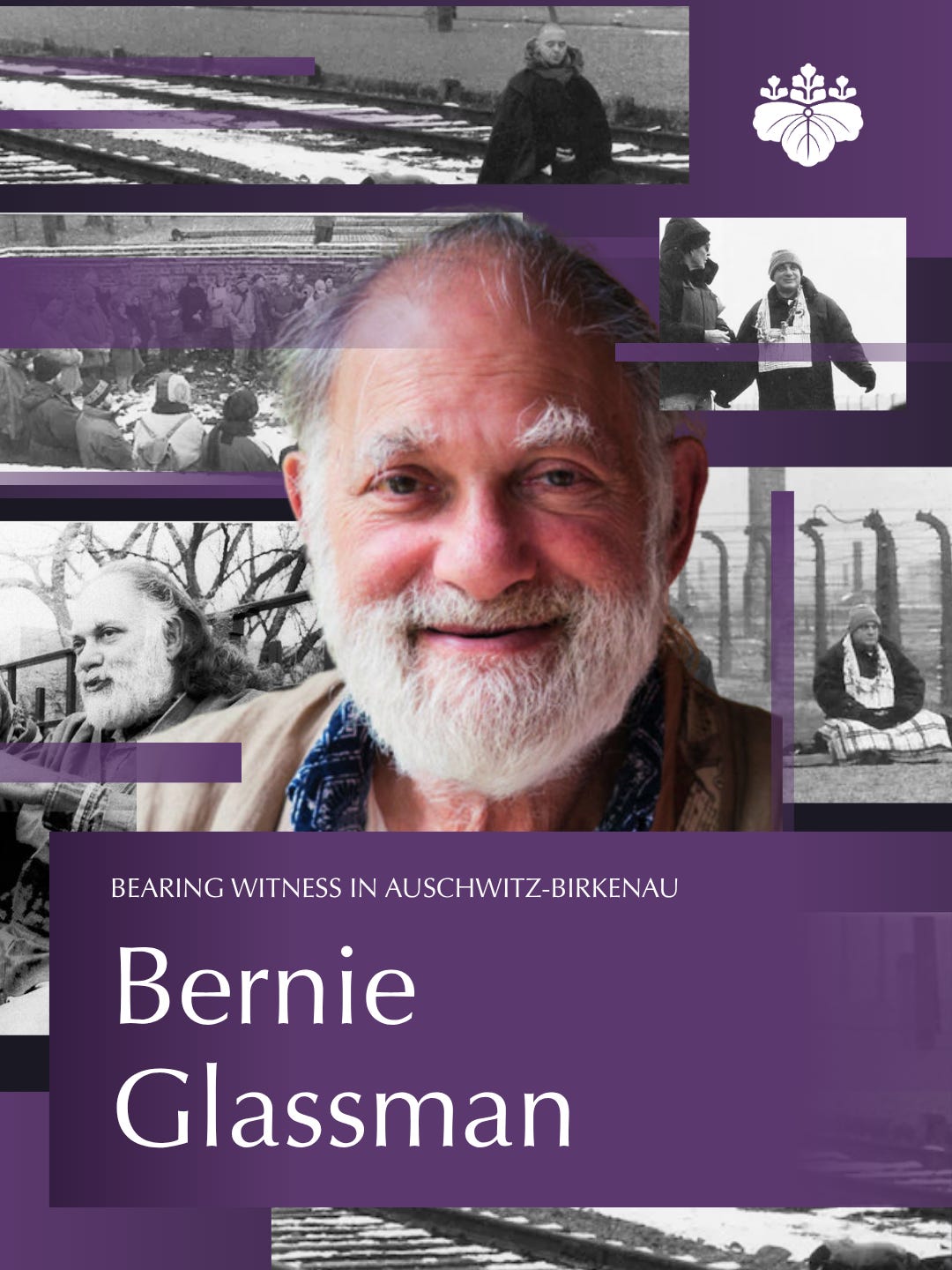
For thirty years, each November, Zen Peacemakers have gone to Auschwitz-Birkenau, a place that has become a monument to intolerance. We come to sit. To face what most of us spend our lives turning away from.
We call this bearing witness.
Shortly after the 20th anniversary of the first bearing witness retreat in Auschwitz, Roshi Bernie Glassman shared what drew him to this place:
The first time I went to Auschwitz, when I walked into Birkenau, I could just feel all the spirits crying out, wanting to be remembered. And so right away I said, I’ve gotta come here and sit and be with those spirits.
It struck me, pretty much right away, that there were all kinds of spirits there. That was a place many Jews were killed, but gypsies and Catholics and intellectuals and gays and people with handicap — so many different kinds.
I felt like I should try to bring as many different kinds of people there to be together, and to see how we can deal with each other.
Jews and Poles and Germans, Buddhists and Christians and the unaffiliated, descendants of victims and descendants of perpetrators — all sitting in the same silence, sharing the same meals, reading the same names aloud.
A place that holds everyone
In Buddhism, Bernie noted, the word for compassion carries two meanings at once: one is compassion as we usually understand it, and the other is removal of fear.
We all talk about the interconnectedness of life. The oneness of life. But if we look carefully at ourselves and see how many aspects of life we shy away from or won’t come in contact with, and then try to figure out why — I think the biggest reason is fear.
What I found for myself was, I needed to go to places where I didn’t want to know what was going on, where I felt I had to stay away, or I was afraid of it. And so those are the places I went.
I think that there’s certain things that we’re afraid of and we stay away. So we’re not in touch with that part of life.
Our work in compassion is to remove fear.
So we go to Auschwitz.
Going beyond fear
In a council group at one of the retreats in Auschwitz sat a German woman whose grandfather had been SS at the camp. She had waited fifteen years to come, afraid she would meet a Jew or a Pole. In the same group sat a man from Krakow who had waited ten years, afraid he would meet a German. They had each spent most of a lifetime avoiding the other.
After four days, they were hugging.
The spectrum of life that each of them could touch had widened enormously.
We do the same in street retreats, where people who would normally cross the road to avoid someone who is homeless instead spend days on the street and learn to ask a simple question: How are you? What’s your name? And also when we sit in the Black Hills with Lakota elders, and listen as they share about boarding schools, beatings, and the graves of children.
We begin in Not-Knowing, setting down our certainty about a place, a history, a person. We Bear Witness to whatever is arising and meet it just as it is. And then, from that intimacy, Taking Action arises – the hug after four days, the name remembered, the ability to respond with love instead of fear.
To go beyond the fear and to celebrate in the diversity of life — that’s beautiful. - Bernie Tetsugen Glassman
Join us this November
We invite you to join Zen Peacemakers in Auschwitz-Birkenau for the Bearing Witness Retreat this year. We will sit together on the selection site, read the names in remembrance, share silence and council and song, and let this place do what it has done for thirty years: open us to one another, and to the parts of life we are most afraid to meet.
Join us in Auschwitz this November. Learn more and register here.
PEACEMAKERS PODCAST


