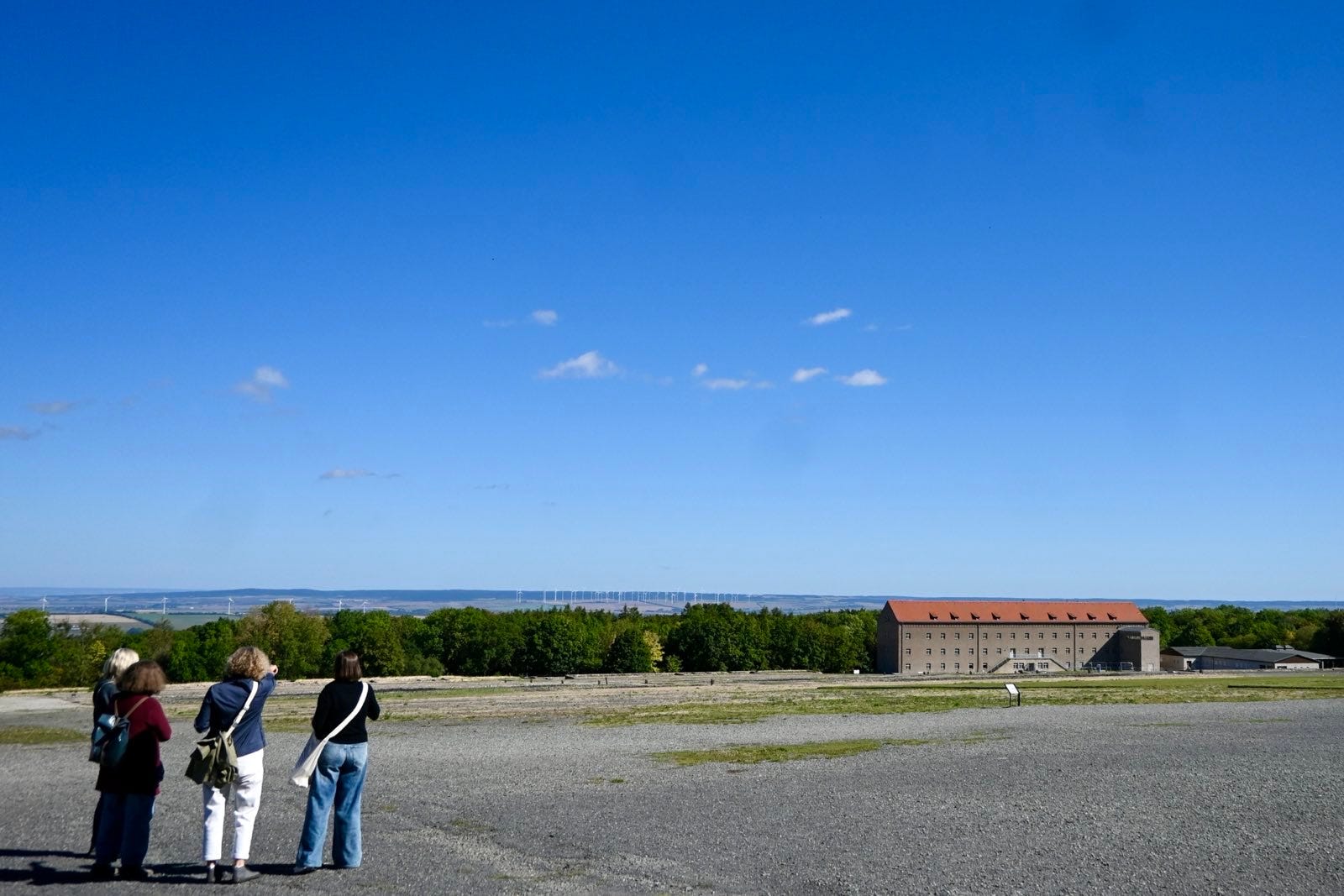
On the last weekend of August 2025, I invited several Peacemakers to Weimar and Buchenwald for a Democracy Dharma Retreat. Since my first visit 10 years ago, I have repeatedly noticed a paradoxical tension between these two places during my visits in subsequent years.
Weimar is a city that stands for classical German culture. Bach, Goethe, and Schiller worked here, to name just a few of the well-known cultural figures. It is also home to the Bauhaus, a school of art and design founded in 1919, which was the home of the avant-garde of classical modernism in the fields of architecture, art, and design.
Weimar was also the place where the first German democracy, the Weimar Republic, was founded in 1919.
Buchenwald, about 6 miles from the center of Weimar, was one of the largest concentration camps on German soil. It stands for the barbaric Nazi dictatorship in Germany. It can be reached by bus in just 20 minutes. Buchenwald was a labor camp for men. Among them were many political prisoners. Their imprisonment also served to destroy democracy so that fascism could run rampant.
Weimar has numerous museums. One of them is the “House of the Weimar Republic.” Here, German history from 1917 to 1933 is meticulously documented. We met there, first watched a documentary about the period, and then explored the exhibition. We learned how depressed the Germans were after losing World War I. Numerous parties were formed. In 1919, the first democratic German government was elected in the Weimar National Theater on the basis of the new constitution. For the first time, women were also allowed to vote. The Weimar Republic was founded.
From the beginning, it was attacked by right-wing and left-wing parties. Until finally in 1933, Adolf Hitler took power as Reich Chancellor after the republic had been infiltrated by right-wing forces for years. This led to the decline of Germany and the catastrophe of World War II and the Holocaust.
We took our time to absorb the facts and then went to the National Theater directly opposite the museum to the monument of Goethe and Schiller. There, on the steps of the monument overlooking the birthplace of the Weimar Republic, we meditated together for the first time. It was Saturday noon, quite lively on the square. It is strange to sit quietly in public in the middle of a city. I was afraid that somebody would approach us, but it did not happen. The images from the exhibition were still swirling around in my head, and people were swirling around me. Nevertheless, sitting made me calmer. It felt like arriving.
Then we took a short break at the nearby Herderplatz to eat and drink something. There we had rented a room in a yoga studio where we retired for meditation and council. A beautiful Tara watched over us and exuded her positive energy.
We ended the evening with a very good Indian meal. On the way back to the hotel, we discovered a deliberately destroyed stumbling stone. Someone had punched several holes in the brass with a sharp instrument. We were speechless and looked disturbed at the expression of anti-semitic hatred in the middle of Weimar`s city center. The past seemed to catch up with us.
The next morning, we met at the train station in bright sunshine to take the bus to Buchenwald.
I asked the participants to remain silent during the trip. Once we arrived, we sat down in a circle around a tree for morning meditation. Our mood was depressed. We started by watching a documentary about the camp. Eyewitnesses also had their say in it. Old men who reported on the terrible conditions in a strangely emotionless manner.
After watching the film, we entered the camp through the gate with the inscription: “Jedem das Seine“ (“To each his own.”) This cynical phrase was intended for the men standing on the roll call square. The square is huge and sloping because it is located on a hillside. A north-facing slope where strong winds often blow. In the cold season, it must have been very unpleasant to have to stand at attention for hours and stare at the camp gate.
We slowly made our way downhill through the camp. Memorial stones for various groups of victims. The ruins of the infirmary. The so-called small camp, the most miserable part at the very bottom. This is where the suffering was greatest. The prisoners lived crammed together in the most confined space under very poor hygienic conditions. For me, the small camp always has a very sad energy.
We sat down there to meditate and became very quiet. A few steps further on were the remains of the children’s barracks. I had decided to bring something for the children: soap bubbles. For a few minutes I let soap bubbles float over the former barracks.
Then we started walking back up towards the camp gate. On the way was the crematorium. I have no words or images for this horrific place.
By now it was noon and we took a lunch break on a lawn between the former SS barracks. Then we continued walking into the forest to a huge earth funnel, the ash grave. From 1944 onwards, the ashes of several thousand people had been disposed of here. The funnel was formed naturally in the rock. It is approximately 30 feet in diameter and 20 feet deep. We sat in a semicircle on our meditation cushions for zazen and gazed into the abyss of the funnel. During kinhin in a circle around the abyss, we had to be very careful not to trip over tree roots, brambles, or anthills. None of us wanted to slip into the funnel through carelessness.
During a meditation session, we recited the names of those who had been murdered. Our voices rang out over the silence of the grave. They were the names of men, fathers, sons, brothers, friends, and lovers. At the same time, I felt the presence of the women who missed and mourned these men: mothers, daughters, sisters, girlfriends, and lovers. How much suffering was associated with these victims.
Finally, we sat down for a last council in the forest. One participant had brought a colorful cloth with the word “peace” written in Arabic and Hebrew. We were all very moved by the experiences of the two days. Salaam and Shalom catapulted us back to our own time, in which the senseless murder of innocent people continues.
People continue to be injured, traumatized, or murdered as a result of wars or violence in autocratic states. Trauma is passed on to descendants, either individually or by entire population groups.
In the past and today, the dismantling of democracies has had catastrophic consequences. And these consequences occur very quickly, as can be seen in countries such as the United States of America or Israel. At the moment, we can see how international fascism is advancing. Meanwhile, the current scientific definitions of fascism can be applied not only to Russia, but also to the United States of America.
Buchenwald is a memorial to the suffering caused when people are excluded, hated, and declared undesirable. This was able to happen because the democratic constitutional state was destroyed.
The retreat made it clear to us once again how important it is to work to ensure that democracy remains intact. And that democracy has to be protected from all sides.
“Democracy is not just a political system, but a way of life,”
Hannah Arendt wrote.
Zen and other forms of spirituality are not just ways of meditating, but ways of life.
A way of life also means being in community. It also means being political. It means being in the company of other people. People who may have different opinions than I do. Listening to everyone and trying to understand their perspective, and not losing sight of human rights in the process.
Council circles can carry the danger that we stop at bearing witness. What matters is what we do with it in our everyday lives. How consistent are we in our way of life. There are many different individual ways to act in everyday life and live democracy.
May we, as individuals and in groups, commit ourselves to promoting and preserving democracy with all our strength!
Undine Nami Bissmeier Sensei, is a registered nurse who lives in Karlsruhe, Germany. She has been involved with Zen Peacemakers since 2012, participating in retreats like the Zen Peacemakers Bearing Witness at Auschwitz/Birkenau Retreat. She is currently in a leadership role (Spirit Holder) for the Auschwitz retreat. Her involvement includes supporting the practice of Zen Peacemakers’ Three Tenets of not-knowing, bearing witness, and taking action.


